
Dia De Los Muertos: Food and Culture
Dia De Los Muertos: Food and Culture

From Ognissantu in Italy to Pangangaluluwa in the Philippines, there are myriads of unique cultural festivities during the month of October. The Mexican holiday “Dia de Los Muertos” is a unique festivity that remembers our loved ones who have passed in a friendly way. I was raised in the United States with Mexican roots and participated in traditions practiced in both cultures. Though I would love to talk about the different celebrations of both cultures, in this blog I will be sharing a little about the Dia de Los Muertos (Day of the Dead) celebration, including the food and culture behind this experience.
History of the Holiday:
The Dia de Los Muertos is a two-day holiday that celebrates the cycle of life and death by honoring family members who have passed away. The actual dates of the holiday are the first two days of November, but traditionally the honoring is from October 28th to November 3rd. Before the celebration starts, we build ofrendas (offerings) to welcome those who have passed away. Ofrendas consist of items that the family members used to love, water, candles, flowers, and of course, food. On the first day of the honoring, families light one candle and place a white flower on their ofrendas to help guide the souls of the cherished family members. The following three days are very similar to the first. Each day respectively, a glass of water, a piece of bread, and the family member’s favorite fruit is added to help the souls in their journey to the ofrendas.
Families welcome the spirits on November 1st. The first souls to arrive will be of those who passed away as children, the adult spirits arrive on the following day. These days are filled with celebration. Families gather together to eat, make candy skulls, and enjoy one another while also saving a spot for the visiting spirits. After the honoring has concluded, families will light one final candle the following day to say goodbye to their loved ones. (A. et al. Day of the dead (dia de los muertos))
Personal Experience:
In my experience, the “Dia de los Muertos” is a very lovely holiday for my family and I. We love to honor my grandparents and set up the ofrendas with bread, apples, and their favorite food. Many foods are commonly eaten on Dia de Los Muertos, and I have had the chance to prepare some myself. Although I am becoming more experienced in making food, nothing will ever beat my mother’s cooking! In the following paragraph, I share some foods eaten during this celebration and their significance to the holiday.
Food and Culture:
Pan de Muertos ( Day of the Dead Bread):
This savory bread treat can be found many days before the actual celebration of Dia de Los Muertos. Although there are many variations of this dish, its meaning is the same for all of them. Pan de Muertos represents those who are being honored. The variations come from the design that is made on the bread. Typically, you will commonly see a bone-shaped design to represent all of the spirits. You may also see angel, toy, heart, or instrument-shaped molds to represent the family’s spirit better. Although Pan de Muertos is typically seen as a desert, a vegan recipe that can be substituted with whole wheat bread flour to make the dish more nutrient-dense!
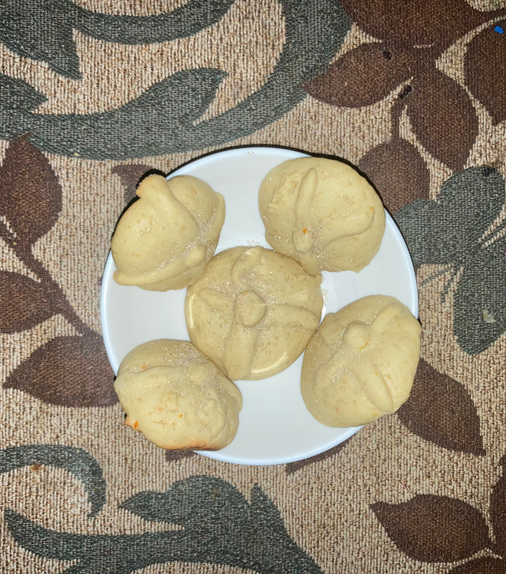
Calaveras de Azúcar (Sugar Skulls)
Another way to honor the dead can be through calaveras de azúcar. These are not typically consumed, but can be a great way to get an entire family involved in Dia de Los Muertos. As the name implies, this dish consists of skulls made purely out of sugar and painted with colorful icing. They can come in different sizes, with the smaller ones intended to represent children. Many bright colors are used to decorate the skulls to show that this holiday is not meant for mourning. The nutrition student in me would love to find a way to make these treats pact with more nutrients, but sometimes that is not possible. Of course, if you would like to eat these sweet skulls, eating them once in a while never hurts!
My Food and Culture:
These two items above are staples in the Dia de Los Muertos celebration. The rest of the items put on the ofrendas are based on what the spirits used to love and vary from family to family. Any food items can be placed on the ofrendas. There are no limitations to what is and is not allowed. For my family, a traditional mole dish, birria tacos, and green pozole are typically eaten during the honoring since they used to be my grandparents’ favorite. I have linked recipes to each dish for you to try at home and explore the traditions of Dia de Los Muertos!
Thank you for reading. Please feel free to comment if you also celebrate Dia de Los Muertos or share any variations you might have made to the dishes . I would love to hear about all of your experiences!
References
- A., Nestor De Buen, et al. “Day of the Dead (Dia De Los Muertos).” Day of the Dead, 2021, dayofthedead.holiday/.
Francisco Rivera
Undergraduate Student | Nutrition Science
President | Student Nutrition Association
Anticipated Graduation: May 2022
Dia De Los Muertos: Food and Culture

CAND Instagram
Recent Posts

Meet the Author
Bringing you the best nutrition information...
Our Academy Bloggers
CAND has several professional and student bloggers. They write about a range of topics for the public.
Es una hermosa tradition
Felicidades, hermosa tradición y con un gran significado espiritual para nuestros seres queridos.
A lovely tradition and amazing food!
Excelente información